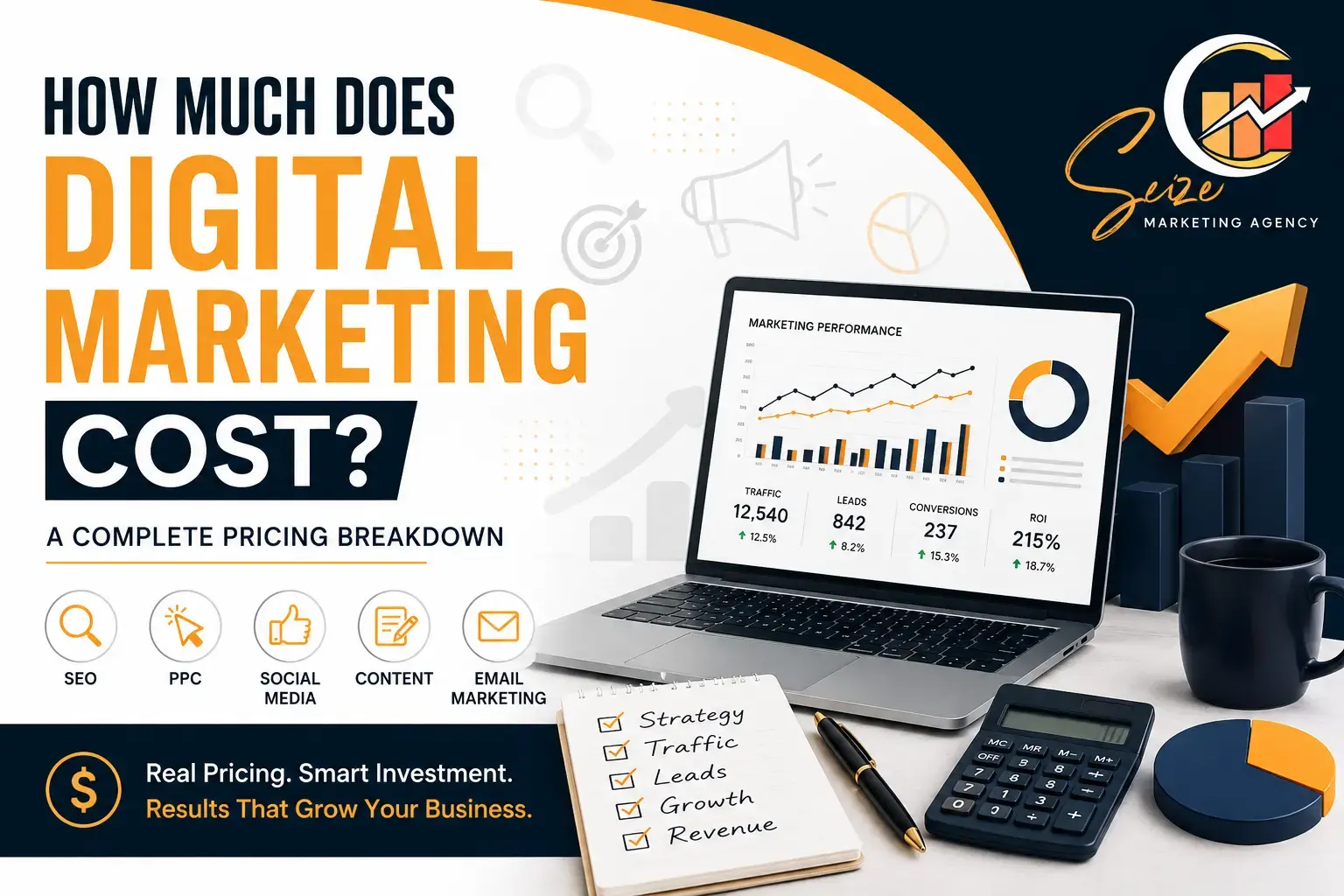
Let’s be honest, “how much does digital marketing cost?” is one of those questions where every answer seems to start with “well, it depends.” Frustrating, right? I get it. You just want a number! And here’s a stat that puts it in perspective: most small businesses spend somewhere between 5% and 15% of their revenue on marketing, yet the actual dollar amounts range wildly, from a few hundred dollars a month for a solo freelancer to tens of thousands for a full-service agency running the whole show.
But that huge range isn’t a dodge. It’s actually the key to understanding what you’re really paying for. Here’s the thing most pricing guides won’t tell you upfront: the cost isn’t about the service; it’s about the outcome you’re buying. A cheap SEO package that never moves your rankings is expensive. A pricier campaign that doubles your leads? That’s a bargain. In this guide, I’ll break down exactly what digital marketing costs in 2026 by service, pricing model, industry, and business size, so you can stop guessing and build a budget that actually works. If you want the bigger picture on where the industry is heading, our overview of the latest digital marketing trends pairs perfectly with this pricing guide.
What Determines the Cost of Digital Marketing?
No two quotes look the same because a handful of very specific factors drive pricing. Before you compare a single dollar figure, understand what’s actually moving the needle on your invoice:
- Business size and current online presence, starting from scratch, costs more than optimizing what you already have
- Your goals, brand awareness, lead generation, and direct online sales all require different levels of investment
- Industry competitiveness: the more crowded your space, the harder (and pricier) it is to stand out
- Geographic scope: local, regional, national, or full e-commerce reach
- The delivery model: freelancer, agency, or in-house team
- The critical split most people miss: ad spend vs. management fees, the money that goes to Google or Meta is separate from what you pay someone to manage it
Common Digital Marketing Pricing Models Explained
Marketers don’t all bill the same way, and knowing the model helps you compare apples to apples. Here are the five you’ll run into most:
- Monthly retainer — a flat recurring fee for ongoing work like SEO, content, or social management. The most common model for long-term growth.
- Hourly rate — freelancers often land between $50–$150/hr; agencies typically $100–$250+/hr. Great for small, defined tasks.
- Project-based / flat fee — a fixed price for a one-off deliverable, like a website build or a campaign launch.
- Percentage of ad spend — common for paid media, usually 10–20% of your monthly ad budget.
- Performance-based — you pay for results (leads or sales). Attractive on paper, but rare and often loaded with fine print.
Digital Marketing Cost by Service

This is the part most people came for. Below are realistic 2026 monthly ranges by service. Treat them as ballparks; your actual number depends on scope and competition.
- SEO — $500–$5,000+/month. Local SEO sits at the lower end; competitive national terms cost more. Staying current on digital marketing trends for local SEO is one of the highest-ROI moves a service-area business can make.
- PPC / Google Ads management — management fees of $500–$2,500/month, plus your ad budget on top.
- Social media marketing — $500–$3,000/month depending on platforms and posting volume.
- Content marketing & blogging — $100–$1,500 per piece, or bundled into a monthly package.
- Email marketing & automation — $300–$1,500/month, with a separate setup fee for automation flows.
- Web design & development — $2,000–$15,000+ as a one-time build, based on size and complexity.
- Local SEO & Google Business Profile management — $300–$1,500/month, essential for any business that serves a specific city or region.
How Digital Marketing Cost Varies by Industry
Two businesses can buy the same services and pay very different prices, because competition, regulation, and customer value differ by industry. A local trade competing on a handful of keywords has a very different budget than a regulated professional service fighting for high-value clients. Here’s how it tends to shake out across a few common niches:
- Contractors & home services — highly local and lead-driven, so budgets often center on local SEO and Google Ads. Our guide to digital marketing for contractors breaks down where those dollars work hardest.
- Medical & healthcare — higher patient lifetime value and compliance requirements push costs up. See how the numbers play out in our breakdown of digital marketing for doctors.
- Financial advisors — trust and content-heavy funnels mean a bigger content and SEO investment. We cover the specifics in our guide to digital marketing for financial advisors.
- Accounting firms — seasonal demand and local competition shape the spend. Learn more in our overview of digital marketing for accounting firms.
How Much Should Small Businesses Budget for Digital Marketing?
If you’re a small business owner, the numbers above can feel intimidating, but you don’t need a giant budget to compete. A common rule of thumb is to allocate 7–10% of revenue to marketing, but honestly, the smarter move is to start lean and scale what works. Many small businesses see real traction on $1,000–$3,000/month when it’s focused. For a deeper, tailored roadmap, our guide to digital marketing for small businesses walks through exactly how to prioritize spend when every dollar counts.
- Startups & very small budgets: focus on one channel (usually local SEO or a lean Google Ads campaign) and do it well
- Growing businesses: layer in content and social once your foundation is generating leads
- Remember that “cheap” marketing often costs more in the long term, low-quality work rarely ranks, converts, or lasts
Freelancer vs. Agency vs. In-House: Cost Comparison

Who you hire changes both your price tag and your results. Each option has a sweet spot:
- Freelancer — the most affordable and flexible, but limited in bandwidth and range of skills.
- Agency — higher fee, but you get a full team, more tools, and strategy across every channel under one roof.
- In-house team — full control, but salaries, software, and training add up fast, often the priciest route.
Not sure which fits your stage of growth? Comparing digital marketing agencies near me is a smart first step; a local partner who understands your market can be worth far more than a cheaper option that doesn’t.
Hidden Costs to Watch Out For
Before you sign anything, look past the headline number. These are the extras that quietly inflate a budget:
- Software and tool subscriptions (SEO platforms, CRMs, ad and email tools)
- Setup and onboarding fees charged in month one
- Ad spend billed separately from management (always ask which is which)
- Contract length and cancellation terms
- Add–ons and scope creep that weren’t in the original quote
How to Get the Most Value from Your Digital Marketing Budget
Spending money is easy. Spending it well is the skill. The single biggest predictor of ROI isn’t how much you spend, it’s whether you spend against a clear plan. Before you commit a dollar, it’s worth building a real digital marketing strategy, so every channel is pulling toward the same goal instead of scattering your budget.
- Set clear, measurable goals before you spend a dollar
- Track ROI and the metrics that matter: leads, cost per acquisition, and conversion rate
- Start with one or two channels and scale what works
- Ask any marketer these questions upfront: What’s included? What’s the reporting cadence? What happens if it doesn’t work?
Is Digital Marketing Worth the Cost?

Short answer: when it’s done right, yes, by a wide margin. Digital marketing typically delivers stronger, more measurable ROI than traditional advertising, and channels like SEO and content compound over time. You’re not renting attention the way you do with a billboard; you’re building an asset. Paid ads bring speed, organic brings staying power, and the best budgets blend both. The clearest sign your investment is paying off? A steady, trackable rise in qualified leads month over month.
Final Thoughts: What Digital Marketing Really Costs
So, how much does digital marketing cost? Somewhere between “less than you feared” and “more than a bargain freelancer will quote you,” depending entirely on your goals. The real takeaway isn’t a magic number. It’s this: focus on value, not price. A well-run campaign pays for itself many times over, while a cheap package can quietly drain your budget with nothing to show for it.
Start by getting crystal clear on what you actually want: more leads, more sales, more visibility, then match your budget to that goal. And when you’re ready to talk real numbers for your business, reach out to Seize Marketing Agency for a custom quote. A quick conversation with a partner who takes the time to understand your goals is always worth it. Your growth is waiting; let’s make your budget work as hard as you do!