
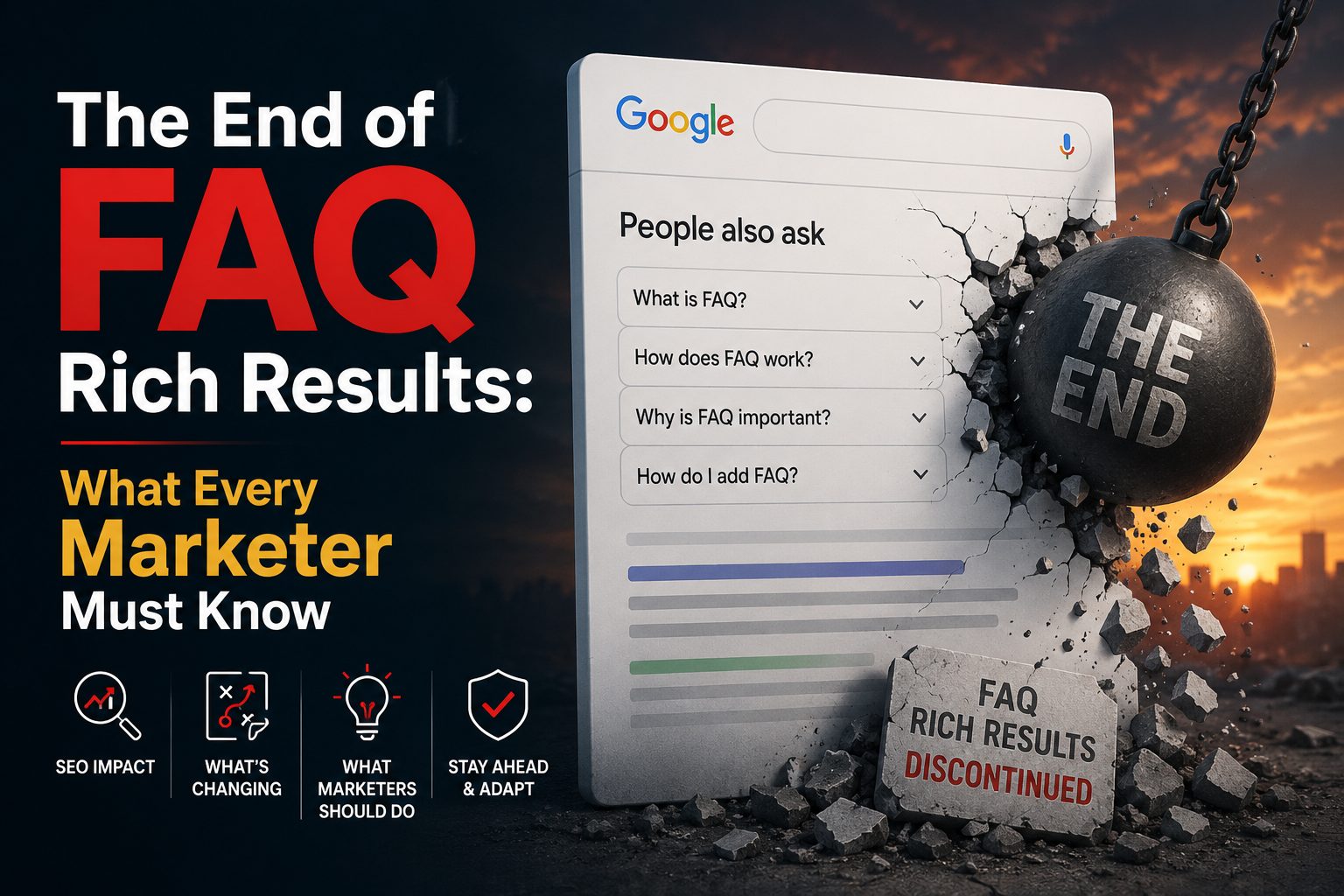
The expandable FAQ dropdowns that once dominated search pages are gone, permanently. Here is what changed, what the end of FAQ Rich Results means for your SEO strategy, and what to do before August 2026.
Google has quietly closed the book on one of SEO’s most widely used schema types. As of May 7, 2026, FAQ rich results, those clickable accordion-style question-and-answer dropdowns that used to extend a webpage’s listing well below competing results, are officially gone from Google Search, no blog post. No explanation. Just a deprecation notice added to Google’s own documentation.
The announcement was brief: FAQ rich results are no longer appearing in Google Search, with full removal of related reporting tools, the Rich Results Test, and Search Console API support rolling out in phases through August 2026. For SEO teams and digital marketers, the change represents the end of a feature that many had spent years optimizing around.
| DEPRECATION TIMELINE | |
| May 7, 2026 | Google is removing the FAQ search appearance filter, the rich results report, and Rich Results Test support from Search Console. |
| June 2026 | Google removes the FAQ search appearance filter, the rich result report, and Rich Results Test support from Search Console. |
| August 2026 | API support for FAQ rich results in the Search Console API will be removed. Development teams should adjust their API calls before this date. |
A Multi-Year Retreat, Now Complete
This deprecation did not come out of nowhere. In August 2023, Google had already restricted FAQ rich results to only government and health websites, removing them for virtually all commercial and editorial sites. At the time, the move also deprecated HowTo rich results on mobile. The May 2026 change completes that withdrawal, ending eligibility for the remaining authoritative sites as well.
Google launched FAQ rich results back in 2019, giving website owners a powerful way to occupy more real estate on the search results page, often increasing click-through rates meaningfully. For nearly seven years, the feature rewarded structured markup with visible search benefits.
“Google removed a display feature, not a schema type. The markup still works. The strategy around it must evolve.”
What You Should (and Should Not) Do
Google’s documentation makes one thing clear: sites do not need to rush to remove FAQPage structured data from their code. The markup will not cause problems for search — it simply will no longer produce visible rich result dropdowns. Other search engines may still process and use it for their own purposes.
However, for teams that track FAQ performance through the Search Console API, updating those reporting pipelines before August is a practical priority. Beyond that, the bigger question is strategic: what role should FAQ schema play in your content going forward?
| SEIZE RECOMMENDATIONS |
| → Do not panic; either keep or remove the FAQ schema from existing pages; it causes no harm and may still serve other purposes. |
| → Update your Search Console API reporting workflows before August 2026 to avoid broken data pipelines. |
| → Evaluate whether your FAQ content is genuinely useful to readers or was added purely for SERP visibility. |
| → Recognize that FAQPage schema is increasingly valuable as an AI citation signal for Google AI Overviews, Perplexity, and ChatGPT Search. |
| → Redirect SEO effort toward content quality, authority signals, and AI-readable structure. |
The AI Search Angle No One Is Talking About
Here is where the story gets more interesting. In 2024 and 2025, a wave of AI-focused SEO advice pushed marketers to implement FAQ schema specifically because large language models prefer clean, parseable question-and-answer pairs. The irony: Google removed the SERP display feature right as the markup became more useful for AI systems.
According to available data, pages with the FAQPage schema are significantly more likely to appear in Google AI Overviews than pages without it. ChatGPT Search, Perplexity, and Gemini all parse FAQ structured data as a primary extraction source for Q&A-style answers. The feature that was used to produce a dropdown in 2021 now helps AI systems find, trust, and cite your content in 2026. AI-referred sessions jumped dramatically through early 2025, and that trend is accelerating.
Google has not connected the deprecation to AI trends, and the absence of any official explanation leaves room for speculation. What is clear is that the era of using FAQ schema to visually dominate a traditional SERP is over. The era of using it to get cited in AI-generated answers may be just beginning.
What This Means for Your Strategy
For most sites, the immediate operational impact is minimal: a reporting cleanup and a schema audit. The larger shift is conceptual. For years, structured data was a tool for earning visible search features: star ratings, FAQs, breadcrumbs, sitelinks. Google has been systematically removing these features as AI-generated summaries absorb more of what rich results used to do.
The brands that will thrive in this environment are those building content that is not just technically marked up, but genuinely authoritative, clearly structured, and written to answer real questions that real users ask. Those are the pages AI systems cite. That is the new real estate.
At Seize, we have been advising clients to think about structured data as an AI readability layer, not just a SERP enhancement tool. This deprecation reinforces that direction. The goal is no longer to win a dropdown. The goal is to become the source that AI trusts enough to cite.
| BY THE NUMBERS | |
| 2019 | Year Google launched FAQ rich results, a 7-year run now ended |
| 3.2× | More likely to appear in AI Overviews with FAQPage schema |
| 527% | Growth in AI-referred sessions between Jan–May 2025 |
| Aug ’26 | Final deadline, Search Console API support removed |
Related News
- Adobe Acquires SEMrush Enterprise SEO 2026: Adobe expands its AI and analytics ecosystem with the acquisition of SEMrush, enabling deeper enterprise SEO and competitive insights in 2026.
- Digital Marketers Conference: Top industry leaders shared emerging trends and strategies for SEO, social media, and performance marketing at the annual Digital Marketers Conference.
- Google Post Scheduling Multi-Location Publishing: Google rolls out multi-location post scheduling, giving businesses a new way to publish and manage posts across multiple locations at scale.
- 2026 Canadian Choice Award Seize Marketing Surrey: Seize Marketing Surrey was honored with the 2026 Canadian Choice Award, recognizing excellence in digital marketing and client results.